
The Visibility Audit.
A customer can find you in more places than ever, and most small businesses are leaking demand on several of them at once. Traditional search, where Google ranks websites. AI answer engines, where ChatGPT, Claude, Perplexity, and Gemini recommend businesses by name. The local map pack, where "near me" searches decide who gets the call. And the review sites your neighbors already trust, like Yelp and Angi. The Visibility Audit checks every one of them in a single free report, scores where you stand, measures the backlink authority behind your site, ranks you against the local competitors winning the searches you are not, and hands you a prioritized fix plan. You decide what happens next.
What a Visibility Audit actually is.
A Visibility Audit is one report that answers a single question: when a customer goes looking for a business like yours, can they actually find you? Getting found is the whole game, and it now happens across several surfaces at once. We score the three that carry a number, traditional Google search, the AI answer engines, and your Google Business Profile, out of 100 each. Then we check where you show up on the directories your customers trust like Yelp and Angi, how much backlink authority your site carries, and where you stand against the local competitors winning the searches you are not. All in plain English, with the few fixes that actually move the needle.
Search Engine Optimization
How Google and Bing rank your website for the queries your customers type. Still the largest single source of traffic for most small businesses, typically 53 percent or more of organic visits.
Generative Engine Optimization
Whether ChatGPT, Claude, Perplexity, Gemini, and Google AI Overviews cite your business when a customer asks them for a recommendation. The fastest-growing search channel, and the one almost nobody has optimized.
Google Business Places
The three-business box with stars, photos, and a Call button that Google shows for "near me" searches, before any website link. For local businesses this is where the call is won or lost.
Where customers vouch for you
Yelp, Angi, and the review counts your neighbors read before they ever call. A great website still loses the job to the competitor with fifty recent reviews on the sites people actually check.
What each part of the audit actually checks.
Search Engine Optimization
SEO is structuring a website so Google and Bing understand each page, trust the site, and rank it above competitors for the queries your customers use. Modern SEO is not keyword stuffing or link farms. It is technical hygiene, on-page clarity, content depth, and discoverability infrastructure. We measure where you stand against 200+ documented Google ranking signals.
| What we check | In plain English | Why it matters to you |
|---|---|---|
| Technical SEO: robots.txt, canonical tags, HTTPS, redirect chains, crawlability, XML sitemap completeness, mobile viewport | The plumbing. The note that tells Google which pages it is allowed to read, a clean map of every page, the little lock that says your site is safe, and no dead-end detours along the way. | If Google cannot crawl a page, it cannot rank it. Broken plumbing quietly caps everything else you do right, and you never see the traffic you lost. |
| Core Web Vitals and page speed: Largest Contentful Paint, Cumulative Layout Shift, Interaction to Next Paint | Google's report card on how fast and steady your page feels: how quickly the main thing loads, whether buttons jump around while it loads, and how snappy it is to tap. A real ranking factor since 2021. | Slow, jumpy pages lose visitors before they read a word, and Google pushes them down the results. Speed costs you on both ends at once. |
| On-page optimization: title tags, meta descriptions, one H1 per page, Open Graph and social-share tags | The headline and blurb people see in Google results and when your link gets shared. One clear main headline per page, and a preview that actually looks good when posted to social. | This is your storefront window in the search results. A weak title and blurb means people scroll right past you to the competitor who wrote a sharper one. |
| Content depth and E-E-A-T: Experience, Expertise, Authoritativeness, Trustworthiness | Whether your pages prove you actually know your trade. Google's way of asking, "is this written by someone who has done the work, and can we trust it enough to recommend?" | Thin pages get outranked by competitors who prove they know the work. This is what earns the trust that puts you at the top instead of page two. |
| Structured data: WebSite, Organization, Service, Product, FAQPage, BreadcrumbList schema | A hidden cheat sheet that spells out your business in a format Google reads perfectly, so you earn the fancy extras in search results like star ratings, prices, and FAQs. | Without it you get a plain blue link while a competitor gets stars, prices, and FAQs that take up three times the space and pull the click away from you. |
| Backlink authority: referring domains, domain and page authority, the ranking power other sites pass to you | The biggest off-page ranking factor. How many trustworthy websites vouch for you with a link, and how much ranking power those votes carry. This is what lets a smaller shop outrank a bigger one on the same search. | This is the single biggest lever between you and a deeper-pocketed competitor. Earn the right links and you can outrank businesses far larger than yours. |
| Link structure and local signals: internal link density, citation consistency, review velocity | How well your own pages connect to each other, whether your business name and number match everywhere online, and how steadily new reviews come in. | Mismatched listings and stale reviews make Google trust you less and quietly cost you rank in the exact towns you are trying to win work in. |
Generative Engine Optimization
When a customer asks ChatGPT, Claude, Perplexity, or Google AI for a recommendation in your industry, does your business show up? For most small businesses the answer is no, even if they rank well on Google. GEO makes your site visible and citable to AI engines, which give direct answers and cite specific sources rather than returning a list of links. Our methodology is backed by published research (Princeton KDD 2024, AutoGEO ICLR 2026).
| What we check | In plain English | Why it matters to you |
|---|---|---|
| AI recommendation and mentions: whether ChatGPT, Claude, Perplexity, and Google AI Overviews actually name your business when asked for the best option in your area | The real test. We ask the AI engines the questions your customers ask them and record whether your name comes up, whose does, and how you are described. | When a neighbor asks ChatGPT for the best in town, one business gets named and called. If that is not you, the job was never yours to lose, because you were never in the conversation. |
| AI crawler access: GPTBot, ClaudeBot, PerplexityBot, Google-Extended and 20+ other AI agents | Whether the robots behind ChatGPT, Claude, and friends are even allowed in the door. Lock them out by accident and the AIs literally cannot see you exist. | Block these by accident and you vanish from every AI answer at once, no matter how good your site is. It is the fastest way to disappear from a channel that only keeps growing. |
| llms.txt and AI discovery endpoints | A welcome mat written for AI. A simple file that hands the AI engines a tidy guide to your best pages instead of making them guess. | The businesses that hand AI a clean guide get quoted first. Skip it and you are betting the AI guesses right about you, which it often does not. |
| Passage-level citability | AI tends to quote bite-sized chunks of about 100 to 170 words. We check which paragraphs on your site are clean and self-contained enough to actually get quoted. | If your best facts are buried in a wall of text, a competitor's cleaner page gets cited in the answer instead of yours, and the customer never sees your name. |
| Brand entity signals: sameAs links to Wikipedia, Wikidata, LinkedIn, Crunchbase and others | The trail of breadcrumbs that proves to an AI you are a real, established business and not a copycat: your verified profiles all pointing back to one another. | This is how an AI tells the real you apart from a copycat with a similar name. Weak signals and it hedges, or quietly credits someone else with your reputation. |
| JSON-LD structured data: WebSite, Organization, FAQPage, Service, Product schema | The same hidden cheat sheet from search, read by the AI engines. It spells out who you are and what you offer in a format machines never misread. | The AI engines read this to get your services, area, and hours exactly right. Leave it out and they fill the gaps with guesses, sometimes with a competitor's details. |
| Per-platform readiness: ChatGPT, Perplexity, Google AI Overviews, Gemini, Bing Copilot | A separate report card for each AI assistant, because being well-known to one does not mean the others have heard of you. We score all five on their own. | Being known to ChatGPT does not mean Perplexity or Google AI has heard of you. We show you which assistants already recommend you and which are handing that customer to a rival. |
Google Business Places
When someone types "painter near me" or "orthodontist in Sellwood," Google does not show your website first. It shows the map pack: three businesses with stars, photos, and a Call button. If you are not in those three, you are invisible. Your Google Business Places listing is the single highest-leverage piece of local-search real estate for a small business, and for most it is the most neglected.
| What we check | In plain English | Why it matters to you |
|---|---|---|
| Claim and verification status | Do you actually own the keys to your own listing? Or is it unclaimed, or worse, claimed by someone who is not you? | An unclaimed or hijacked listing is a storefront with someone else's hands on the register. Until you own it, you cannot fix a single other thing on this list. |
| Category selection | Whether you picked the category customers really search for. The right choice alone can lift you from page 3 into that three-business map box. | Pick the wrong category and Google shows you for searches nobody makes. The right one, by itself, can move you from invisible into the three-business map box. |
| Name, address, phone consistency across Google, Bing, Apple Maps, Yelp, Facebook and 30+ directories | Does your business name, address, and phone match everywhere on the internet? When they disagree, Google gets nervous and quietly ranks you lower. | When your details disagree across the web, Google stops trusting them and ranks a competitor whose line up. It is free to fix and expensive to leave alone. |
| Photos, reviews, and posts: count, freshness, velocity, response rate, publishing cadence | Whether your listing looks alive: plenty of recent photos, a steady stream of reviews you reply to, and regular posts, versus a dusty page nobody has touched in a year. | A live, well-tended listing wins the click over a dusty one every time. This is often the whole difference between the three businesses shown and the ones nobody sees. |
| Services, attributes, and Q&A | Is everything you offer actually listed, with the right checkboxes ticked, and common questions answered by you, before a competitor answers them for you? | Every unanswered question is one a competitor gets to answer for you, in their favor. Complete listings simply get more calls than half-filled ones. |
| Competitor snapshot and Insights | Where your three closest rivals stand for your top searches, plus a 90-day look at how many people called, asked for directions, or clicked through, if you own the profile. | You cannot beat rivals you cannot see. This shows exactly who is ahead of you in the map pack and by how much, so the fixes are aimed rather than guessed. |
Directory & review presence
Before a customer ever reaches your website, most of them check the places their neighbors already trust: Yelp, Angi, and the Google map pack. A polished site with a thin or missing presence on these platforms still loses the job to a competitor with fifty recent reviews. We check where you actually show up, how you are rated, and where you rank against the local businesses winning that work.
| What we check | In plain English | Why it matters to you |
|---|---|---|
| Yelp presence, rating, and review count | Whether you have a real, claimed Yelp page, what your star rating is, and how many reviews stand behind it. | For many trades Yelp is the second search engine. A missing or thin page here quietly kills calls from people who were ready to hire you. |
| Angi presence, rating, and review count | The same for Angi, the directory homeowners use specifically to shortlist contractors and service pros. | Homeowners on Angi are ready to book. If you are not listed, or listed with stale reviews, you are handing warm, high-intent leads to the pro next to you. |
| Rank against local peers on each surface | Where you land versus the nearby businesses your customers see right beside you, on each platform and in the map pack. | Being listed is not enough if three competitors sit above you. This shows the exact gap to close, and which surface will win you the most work when you do. |
One report. Every surface scored.
The Visibility Audit is a single, professionally formatted, plain-English report that scores your Search Engine Optimization, Generative Engine Optimization, and Google Business Places presence side by side, checks where you stand on the review sites your customers use like Yelp and Angi, measures your backlink authority, and ranks you against the local competitors in your market. Then it hands you a prioritized, page-by-page fix plan. It is a deliverable in its own right: written for an owner or operator to read, not a developer.
Book a discovery call and we will walk you through a live one on your own business.
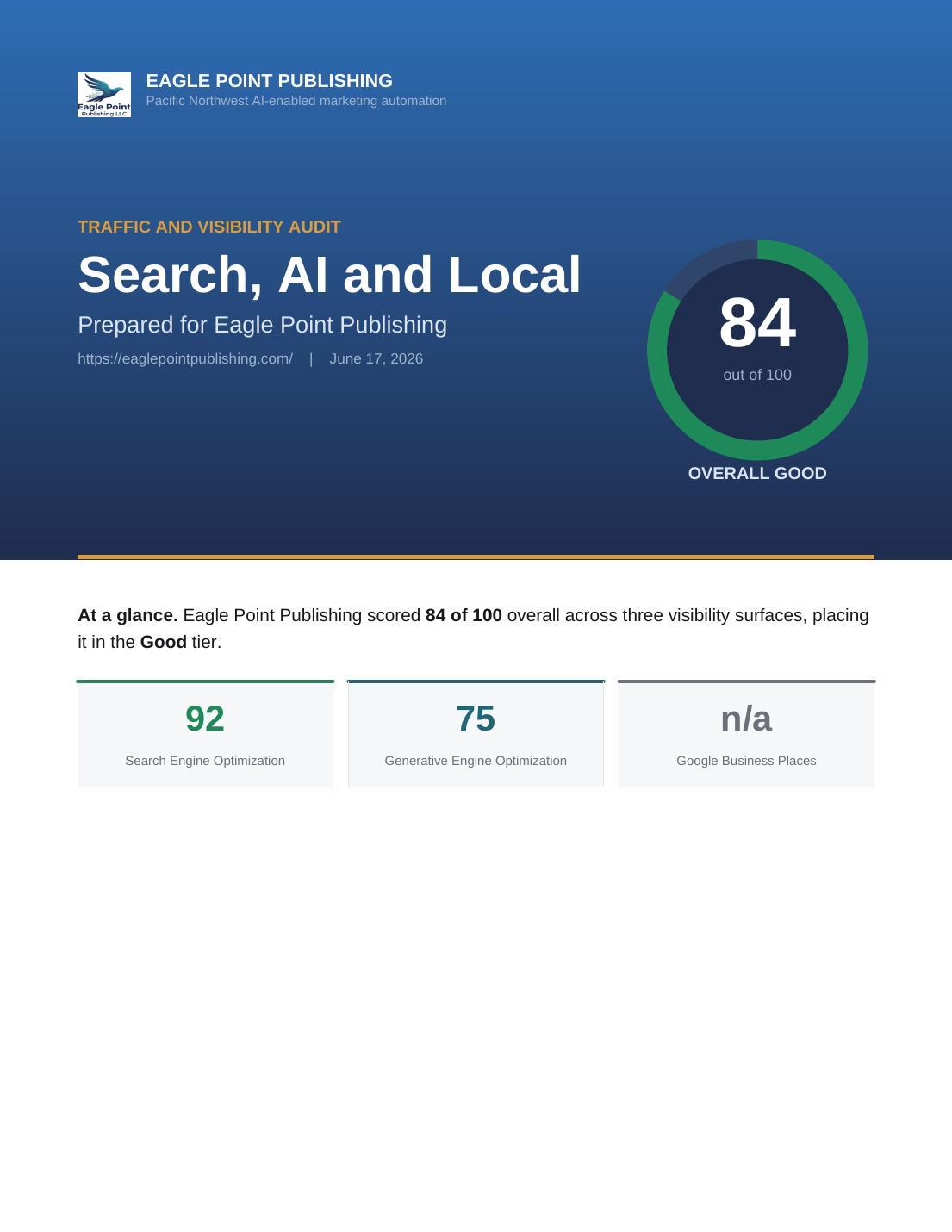
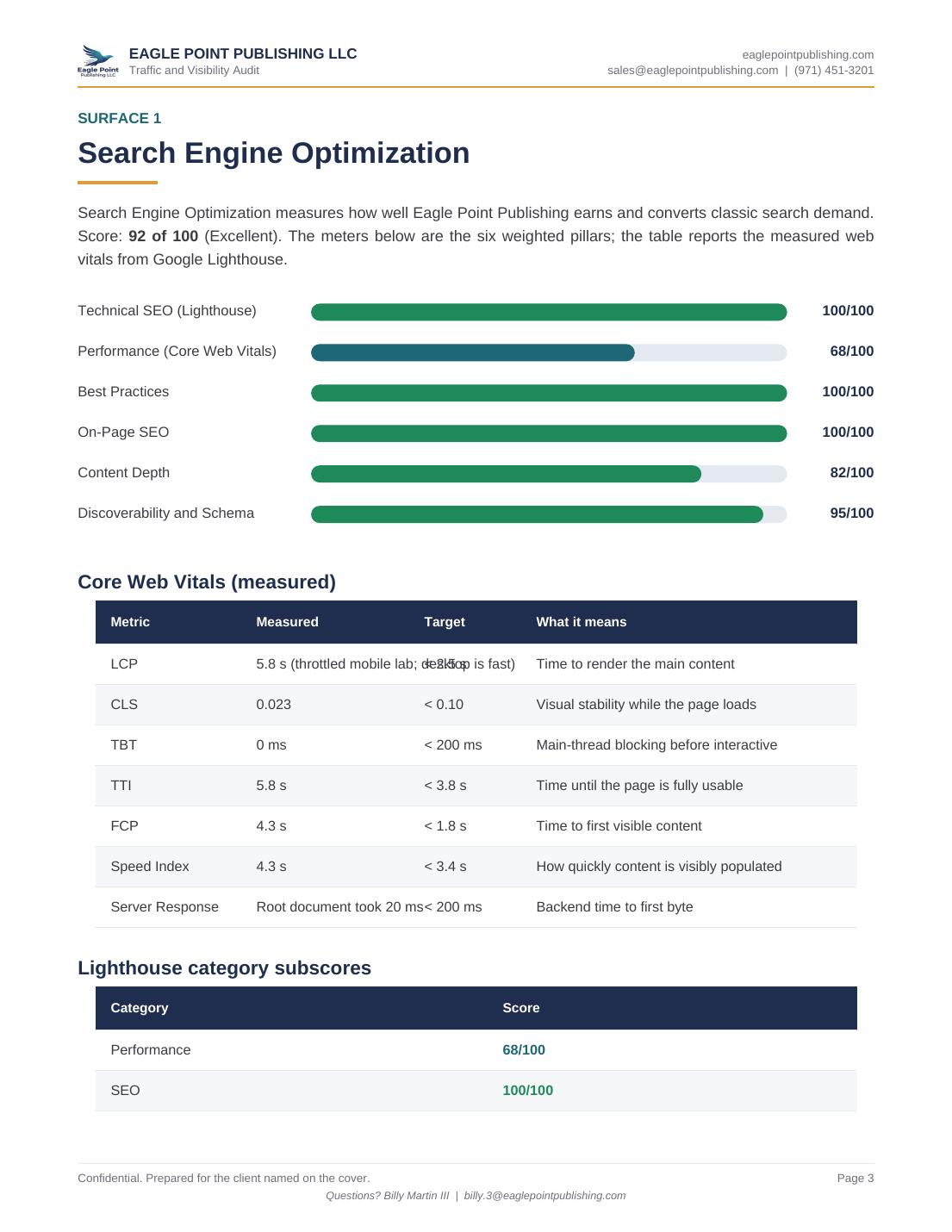 What you receive · multi-page audit
What is inside
- Three headline scores, 0 to 100, for traditional search, AI answer engines, and your local listing, with the tier band for each (critical, foundation, good, excellent).
- Directory and review-site presence: where you show up on the platforms your customers check, like Yelp and Angi, your rating and review count on each, and how you rank against nearby businesses on the same surfaces.
- Backlink authority: how many trusted sites link to you, the ranking power those links carry, and how that stacks up against the competitors you are trying to outrank.
- The competitive landscape: which local businesses win the searches you are absent from, the keyword gap between you and them, and your position in the pack.
- Category sub-scores under each: technical, performance, on-page, content quality, schema, citability, brand authority, and local-listing completeness.
- Per-surface readiness for Google, Bing, Mobile, and Local search; for ChatGPT, Perplexity, Google AI Overviews, Gemini, and Bing Copilot; and a map-pack position snapshot against your closest competitors.
- Plain-English executive summary suitable for the owner, operator, or a non-technical team member.
- Severity-ranked findings (critical, high, medium, low). Each one names what it is, why it costs you customers, and the specific fix.
- One prioritized action plan across everything we check, split into quick wins, this-month fixes, and longer strategic moves.
- Crawler and AI-agent access tables covering Google, Bing, and the AI-era bots (GPTBot, ClaudeBot, PerplexityBot, Google-Extended).
- Schema and structured-data inventory: which JSON-LD types are present, which are missing, and what each missing one would unlock.
What does your score actually mean?
Each discipline is scored 0 to 100 and mapped to the same four bands, defined by the underlying audit tooling, not our opinion. The bands describe the observed behavior of search engines, AI engines, and the map pack when deciding whether to surface your business for the queries your customers use.
Where the data is strong: the bands reflect measurable, objective signals (Lighthouse scores, schema presence, meta-tag correctness, robots.txt config, citability scoring, listing completeness). Where we will not invent numbers: there is no universal formula that turns a score into a guaranteed traffic or revenue figure. Outcomes depend on your industry, competitive set, content velocity, and how often your customers search in the first place. Anyone quoting you a specific uplift without seeing your data is guessing. We will not.
Search engines, AI engines, or the map pack largely cannot find, parse, or trust you. You are effectively absent when customers look, and competitors with even baseline optimization absorb the demand in your category.
The basics are in place. You show up for easy, long-tail queries but are inconsistent on core category terms, rarely above the fold, and not yet a default citation or a map-pack regular. Plenty of reachable ground left.
You rank, get cited, and appear in the map pack competitively on core queries. Traffic and calls are reliable and growing. The remaining gap is usually content depth, technical polish, or rich-result and review coverage.
You are at or near best-in-class: stable top-of-page rankings, a default reference across AI engines, and a consistent map-pack presence. Further growth comes from new content, reviews, and backlinks rather than fixes.
Honest ROI framing
The numbers below are verifiable, published, and independent of our service. Use them to frame the opportunity for your own business. We will never quote you an uplift percentage we cannot source.
Translation: if you are not ranking on page 1, not cited by the AI engines, and not in the map pack, you are losing the majority of your addressable demand to whoever is. We will walk through the specific math for your business on the free consult, using your actual data, not a canned projection.
Why you need this now.
Three patterns we see on nearly every business we audit.
Your website is quietly leaking rank
Meta tags out of range, empty sitemaps, schema absent on service pages, Lighthouse findings nobody has seen. Each is a silent tax on your rank. Nobody tells you; competitors just keep outranking you, and the gap widens every quarter.
Your customers already ask AI
ChatGPT, Claude, Perplexity, and Gemini compressed the search market in under two years, and most people never click a source link. Only about 23 percent of competitors have optimized for it. The window to leapfrog them is open right now.
Your map-pack listing is costing you calls
Most local listings are incomplete, stale, missing photos, missing reviews, or unclaimed. Every week those gaps hand calls to the three competitors who bothered to optimize. The owner wonders why business is slow. It is not the market. It is the listing.
None of this is a seasonal push. It is maintenance infrastructure, like accounting or insurance. The fixes are mostly mechanical and they compound: a sitemap published once stays published, schema persists, a claimed listing stays claimed. Businesses that invest consistently build a durable moat across every channel. The ones that do not keep ceding ground to whoever did.
The audit is free. The fix is your choice.
Right now we run the full Visibility Audit for every business at no cost, and the report is yours to keep with no obligation. Once you have seen your scores, you decide how the work gets done. There are three ways forward.
Free, for now
The complete report, no cost.
- Every channel scored, from Google search to the AI answer engines to your local listing and review sites, with every finding ranked by impact in plain language.
- Yours to keep and act on however you want. Many of the fixes you can do yourself.
- We are offering this free while we grow. That will not last forever.
We implement it once
Short on time or technical hands?
- We work through the prioritized findings, make the fixes, and hand the result back to you.
- A single scoped project with a clear start and finish, not a subscription.
- The mechanical work, sitemaps, schema, on-page fixes, listing cleanup, stays fixed once it is done.
We keep it sharp
For the parts that reward upkeep.
- Some visibility compounds with attention: fresh map posts, review responses, new content, and re-audits.
- We maintain it on a schedule and report what is working each month.
- Entirely optional, and only worth it where the upkeep pays for itself.
All three paths start the same way: a free report on your business, covering every place a customer can find you. Book a quick call and we will run it.
Case study: our own site.
Before we sold this service, we ran the whole audit on ourselves, eaglepointpublishing.com, and published the real numbers.
- Generative Engine Optimization: baseline 31 out of 100, critical tier, invisible to AI search. A 27-change fix plan (AI crawler allowlist for 25 bots, llms.txt, full schema graph, AI discovery endpoints, content restructuring, brand entity anchors) took us to 81, and the current score under a tougher check suite is 85 out of 100, good tier. A +50 point move. Per platform: ChatGPT 30 to 80, Perplexity 20 to 70, Google AI Overviews 25 to 80, Gemini 25 to 75, Bing Copilot 20 to 70.
- Search Engine Optimization: baseline 85, already good (the GEO work had covered overlapping schema). Five prioritized fixes (title tag 99 to 50 characters, meta description 245 to 150, a spec-compliant sitemap with all 14 URLs, descriptive link text, robots.txt verification) took us to 99 out of 100, excellent tier. A +14 point move. Category moves: On-Page 80 to 100, Discoverability and Schema 70 to 100, Lighthouse SEO 92 to 100.
- Google Business Places: claimed and verified the listing, corrected categories and name-address-phone consistency across directories, and built out services, attributes, and Q&A from the audit's fix plan.
We will not promise the same deltas on every site. A typical small business without prior optimization usually scores lower at baseline, which leaves much more room to grow. What we will promise is transparency: you get the real baseline, the real fixes, and the real post-fix re-audit. No cherry-picked numbers.
Thirty-minute free consult. No obligation, no pressure.
We will look at your business, score it, and hand you the findings. One report covering Google search, the AI answer engines, the local map pack, and the review sites your customers check, plus your backlinks and how you rank against local competitors. Talk to Eryn, our AI receptionist, in your browser to get started, or email us directly at billy.3@eaglepointpublishing.com.